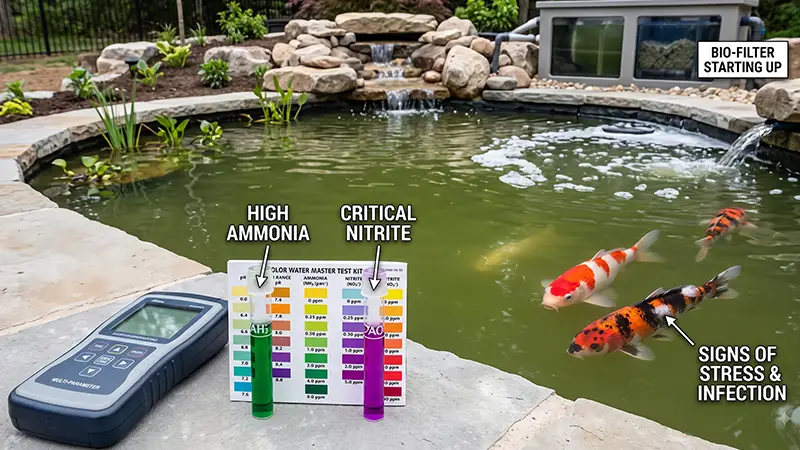
You’ve just built your dream pond. It’s filled with crystal clear water, the pumps are humming, and you’ve added your first beautiful koi. Everything looks perfect. But beneath the surface, a biological ticking time bomb has just started.
A few weeks later, your fish are sitting on the bottom with clamped fins. Some are gasping at the waterfall. You test the water, and panic sets in. Welcome to New Pond Syndrome (NPS).
NPS is simply the painful, necessary process of your pond’s biological filter establishing itself. It is a war of three stages: Ammonia, Nitrite, and Nitrate. Understanding how these three elements interact—and knowing what to do during each phase—is the difference between losing your fish and raising healthy champions.
Stage 1: The Ammonia Spike (The Silent Burn)
The moment you add fish to a new pond, they begin producing waste. This waste, along with uneaten food, breaks down into Ammonia (NH3). In a mature pond, beneficial bacteria instantly eat this ammonia. But in a new pond, those bacteria haven't grown yet. With nowhere to go, ammonia builds up rapidly.
Ammonia burns the gills and skin of your koi, leading to severe stress, flashing (flicking against objects), and eventual death. However, there is a massive misconception in the hobby: Your liquid drop test is lying to you.
Standard test kits measure Total Ammonia Nitrogen (TAN). But only a fraction of that total reading is actually the toxic "Free Ammonia" (NH3). The toxicity of ammonia is entirely dependent on your pond's pH and Temperature. An ammonia reading of 0.5 mg/L at 15°C with a pH of 7.0 is virtually harmless. That exact same 0.5 mg/L reading at 25°C with a pH of 8.5 is highly toxic.
Stop Guessing with Ammonia
Don't rely on basic test kit colours. Use our calculator to factor in your pH and temperature, and find out exactly how much toxic Free Ammonia is actually in your water right now.
Open Ammonia Safety CalculatorStage 2: The Nitrite Spike (The Suffocator)
Eventually, the first type of bacteria (Nitrosomonas) grows and starts eating the ammonia. You will see your ammonia levels drop to zero, and you'll think you are safe. You aren't.
When bacteria consume ammonia, their waste product is Nitrite (NO2). Now, a second type of bacteria (Nitrobacter) needs to grow to eat the Nitrite. But Nitrobacter grows incredibly slowly. This creates the dreaded Nitrite Spike.
Nitrite is arguably worse than ammonia. It binds to the hemoglobin in your koi's blood, turning it brown and preventing it from carrying oxygen. This is known as "Brown Blood Disease." Your fish will literally suffocate in highly oxygenated water.
The Chemistry Flip: Unlike ammonia, which gets worse at high pH, Nitrite actually becomes more toxic at lower pH levels because it forms dangerous nitrous acid.
The Antidote: Salt. Adding pure PDV (Pure Dried Vacuum) salt to your pond introduces Chloride. The Chloride ions physically block the Nitrite from entering the fish's gills, acting as a direct shield while you wait for your bio-filter to mature.
Calculate Your Salt Shield
To protect your fish from Nitrite poisoning, you need a precise salinity level (usually around 0.1% to 0.3%). Calculate exactly how many kilos of PDV salt your pond needs.
Open Salinity CalculatorStage 3: The Nitrate End-Game
Finally, your slow-growing Nitrobacter colonies establish themselves. Your Nitrite levels drop to zero. The cycle is complete, and your filter is officially "mature."
The byproduct of the second stage is Nitrate (NO3). Compared to ammonia and nitrite, nitrate is vastly less toxic. Your koi can tolerate much higher levels of it. However, if left unchecked, high nitrates will cause massive blanket weed and algae blooms, stunt your koi's growth, and suppress their immune systems over the long term.
Because traditional bio-filters do not consume Nitrate, the primary ways to remove it are through regular water changes or by incorporating aquatic plants (like a veggie filter or lily baskets), which will happily absorb the nitrates as fertiliser.
Manage Nitrates with Water Changes
The secret to keeping Nitrates low and water crystal clear is consistent dilution. Plan your weekly interval changes or set up an automated 24/7 trickle-in system.
Open Trickle & Change CalculatorThe Golden Rule of New Ponds
Surviving New Pond Syndrome requires patience. Do not overfeed. Your fish will not starve if you stop feeding them for a few days to get a toxic spike under control. Test your water frequently, watch your fish's behavior, and let the biology take its course.