Ask any beginner what the most important part of koi keeping is, and they will all give you the same answer: The Nitrogen Cycle. We are taught from day one to obsess over ammonia, nitrite, and nitrate. We buy massive bio-filters, load them up with K1 media, and test our water religiously.
But here is the secret that most hobbyists miss until it’s too late: Your nitrogen cycle cannot run without KH.
While everyone is busy staring at ammonia readings, Carbonate Hardness (KH)—also widely known in the hobby as Total Alkalinity—is operating behind the scenes. It is the fuel that feeds your filter, the shield that protects your fish, and the only thing standing between your pond and a catastrophic pH crash. Here is why understanding KH and Alkalinity is the most important leap you can make from a beginner to a pro koi keeper.
KH is Filter Food (The Consumption Math)
Most keepers think of KH as a static number—a water parameter that just "is." In reality, KH is a consumable resource.
The beneficial nitrifying bacteria in your filter (the ones that eat toxic ammonia) require carbonates to survive and multiply. For every 1 milligram of ammonia your filter processes, your bacteria consume exactly 7.2 milligrams of carbonates.
During the peak of summer, when temperatures are high and you are feeding your koi heavily, your fish are producing massive amounts of ammonia. Your filter works overtime to process it, which means your bacteria are rapidly eating through your pond’s alkalinity reserves. If you aren't actively replenishing it, it will eventually run out.
The UK Weather Threat: Heavy Rain
In the UK, our weather adds another massive layer of risk. Rainwater is slightly acidic and contains absolutely zero KH.
If your pond is sitting at a borderline level (around 3 dH) and we get a weekend of torrential downpours, that fresh rainwater will dilute your pond's overall alkalinity. It can easily wipe out your remaining carbonates overnight, leaving your water entirely unbuffered.
The Domino Effect: What a pH Crash Actually Looks Like
When your KH hits zero, you lose your chemical buffer. This triggers a terrifying domino effect known as a pH crash:
- The Shield Breaks: Without alkalinity to buffer the acids produced by the filter and the fish, the pond's pH plummets rapidly.
- Acidosis Sets In: The highly acidic water literally burns the skin and delicate gill filaments of your koi, causing severe stress, flashing, and lethargy.
- The Filter Dies: Nitrifying bacteria cannot survive in highly acidic environments. As the pH drops, your bio-filter rapidly dies off.
- The Ammonia Spike: With the filter dead, the ammonia produced by your fish has nowhere to go. It spikes to lethal levels, compounding the crisis.
A pH crash is one of the most devastating events in koi keeping, but it is also 100% preventable.
The Manual Fix: Safe Bicarbonate Dosing
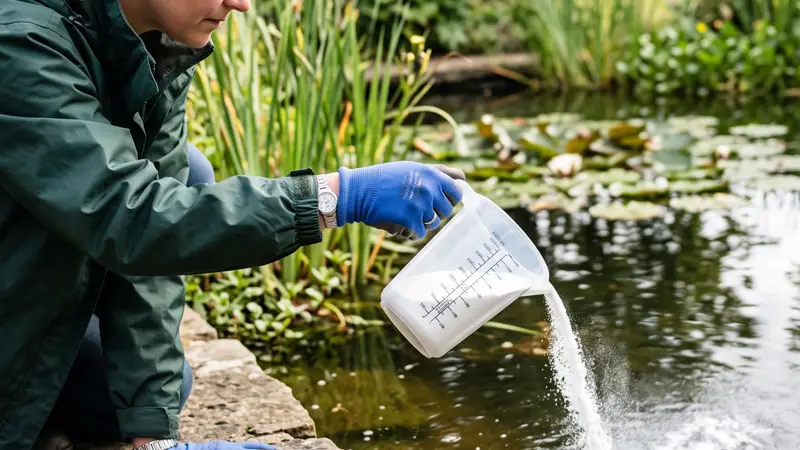
The ideal KH range for a koi pond is between 4 and 8 dH (approx. 70 to 140 mg/l). To keep your levels stable, you must test your alkalinity weekly and replenish it using Sodium Bicarbonate (baking soda). However, raising KH too quickly will cause your pH to swing violently, resulting in "hardness shock. To determine your dose manually, you first need to calculate the difference between your current KH and your target KH in dH. Because sodium bicarbonate is only partially carbonate (roughly 71.43%), the standard, trusted field rule is to add exactly 30 grams of sodium bicarbonate for every 1,000 liters of pond water to raise the KH by 1 dH. Our calculator automatically applies this ratio to give you a perfectly safe and accurate dose."
Open KH Buffer CalculatorThe Pro Level: Stability and Automation
While manual dosing works, the ultimate secret to growing jumbo, champion-level koi is stability. Your fish do not like a rollercoaster environment where KH drops all week and then spikes on Sunday after a water change. They thrive in a flatline environment.
If you are serious about water quality, the pro-level advice is to remove human error entirely and automate your buffering. Modern pond systems utilize automated dosing pumps that drip tiny, precise amounts of liquid buffer into the water 24/7. Respected water quality expert Andy at Finch Filtration supplies some of the best auto-dosing setups in the industry. By utilizing an auto-doser, your KH never dips, your pH remains locked in place, and your bio-filter performs at maximum efficiency all season long.
Frequently Asked Questions
Is KH the same as Total Alkalinity?
In the koi keeping hobby, the terms KH (Carbonate Hardness) and Total Alkalinity are generally used interchangeably. Technically, alkalinity measures the water's total ability to neutralize acids, while KH measures specifically the carbonates and bicarbonates. However, in a typical koi pond, carbonates make up nearly all of the alkalinity. If your test kit or strips read "Total Alkalinity," you can treat it exactly the same as KH.
What is the ideal KH for a koi pond?
The sweet spot for most koi ponds is between 4 and 8 dH (70 to 140 mg/l). This provides a strong enough buffer to prevent pH crashes while keeping the water comfortable for the fish.
Can I use supermarket baking soda to raise KH?
Yes. Standard Sodium Bicarbonate from the supermarket is perfectly safe for koi ponds, provided it is 100% pure with no added flavorings or anti-caking chemicals.
Does salt affect KH?
No. Adding PDV salt to your pond for parasite treatments or osmotic support will raise your salinity, but it does not directly alter your Carbonate Hardness (KH) or alkalinity.