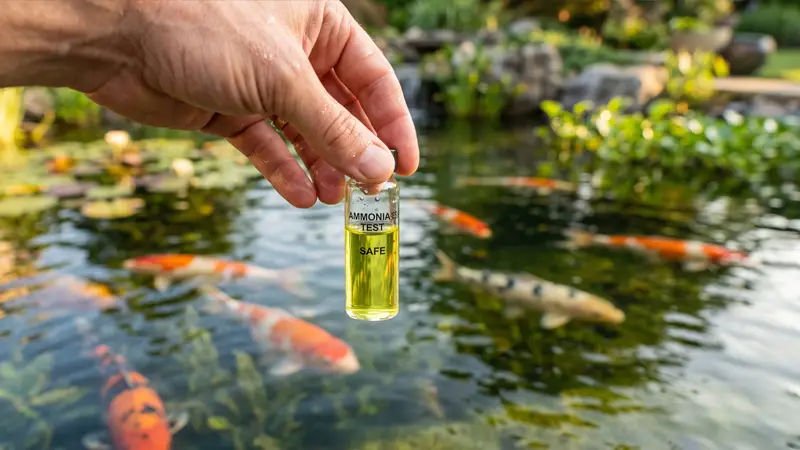
You wake up, grab a coffee, head out to the pond, and run your liquid drop test. The vial turns a light green—there is a little Total Ammonia, but nothing alarming. You go to work thinking your fish are perfectly safe.
By 4:00 PM, your koi are gasping at the surface, suffering from acute respiratory distress and chemical burns to their gills.
Here is the scientific reality: Your morning ammonia test might be lying to you because of how your pond breathes during the day.
The Two Faces of Ammonia
Standard liquid drop test kits measure Total Ammonia Nitrogen (TAN). However, reporting TAN without further calculation is fundamentally misleading. TAN is actually made up of two distinct parts:
- Ionised Ammonium (NH4+): Relatively benign and safe for your fish.
- Un-ionised Free Ammonia (NH3): Highly toxic, with elevated levels causing neurological impairment, acute gill damage, and mortality.
Ammonia exists in a constant, dynamic equilibrium between these two states. The balance is dictated entirely by two factors: water temperature and pH. As your temperature and pH rise, that safe ammonium rapidly converts into highly toxic free ammonia.
The Morning Trap: Photosynthetic pH Swings & Low KH
Ponds containing algae or submerged plants undergo a daily cycle of photosynthesis. During daylight hours, these plants consume dissolved carbon dioxide (CO2) from the water.
Because dissolved carbon dioxide acts as a weak acid in the form of carbonic acid, its removal naturally encourages the pond's pH to rise by late afternoon.
Will this cause a massive shift in every pond? No. This is exactly why your Carbonate Hardness (KH) is so important.
KH acts as a chemical shock absorber. If your pond has a healthy KH level (between 4 and 8 dH), it buffers against these daily changes, keeping your pH firmly locked in place. However, if your filter has depleted your KH reserves and your water is unbuffered, your pH is free to fluctuate significantly. In a low-KH pond, an ammonia reading that is perfectly safe at a morning pH of 7.5 can easily cross into the danger zone by 4:00 PM when the unbuffered pH peaks at 8.5.
The Mathematics of Toxicity
To understand exactly how dangerous this shift is, we rely on peer-reviewed science. The dissociation constant (pKa) of ammonia decreases as temperature increases, following the equation established by Emerson et al. in 1975:
Where T represents the water temperature in degrees Celsius.
Once the dissociation constant is determined, the fraction (f) of total ammonia that exists as toxic free ammonia can be calculated utilising the water's pH:
A Real-World Example
Let's look at how a seemingly "safe" but unbuffered pond turns toxic in a matter of hours:
- 8:00 AM (The Test): You test your water and get a TAN reading of 2.0 mg/l. The water is 21°C, and the morning pH is 7.0. According to the maths, your toxic free ammonia is approximately 0.01 mg/l. This is in the safe, green zone (< 0.02 mg/l).
- 4:00 PM (The Reality): You haven't added any more ammonia, but the sun has caused the algae to consume the CO2, pushing the unbuffered pH up to 8.5. At that exact same 2.0 mg/l TAN reading, your toxic free ammonia is now 0.30 mg/l. This is deep into the red danger zone (> 0.04 mg/l). Your fish are now experiencing acute physiological shock.
Stop Guessing. Start Calculating.
This daily vulnerability is exactly why you must calculate your worst-case scenario. Always test your pH in the late afternoon when it is at its highest, and input that number—along with your peak temperature and TAN reading—into our Ammonia Toxicity Calculator to find out exactly how much toxic NH3 is really in your water.
Open Ammonia Safety CalculatorRestore Your Pond's Defences
If you suspect your pH is fluctuating, use our KH Buffer Calculator to safely calculate the exact dose of sodium bicarbonate needed to lock your pH in place and prevent a catastrophic crash.
Open KH Buffer Calculator